Language Exchange at Blue House Okinawa
Language Exchange Is Where the Give-and-Take of Learning Happens
Don’t wait for perfection to participate. Start with what you can.
You may understand the Japanese when you study it and still think, “I’m nervous about speaking in Japanese to locals…” when a real person is sitting in front of you. Language Exchange gives you a place to take that first small step: bring the Japanese you have been learning into a real conversation and try one question.
On This Page
Japanese School
When the Japanese You Studied Gets a Real Answer
Maybe a question such as “What did you do this weekend?” felt easy enough when you practiced it. Then you sit down with another person, feel that little bit of nervousness again, and say it anyway.
This time, the answer does not come from a textbook, worksheet, or example sentence. Another person actually answers you.
The reply may be close to what you imagined, or it may be something you never expected. Either way, the Japanese you studied has already done something different: it helped you ask a real person something you wanted to know.
And for a moment, you realize something simple but important: your Japanese was not perfect, but they understood what you were trying to say.
You do not need to arrive ready to talk about anything and everything. Before you start, you can decide what you would actually like to ask.
See how our in-class Language Exchange started
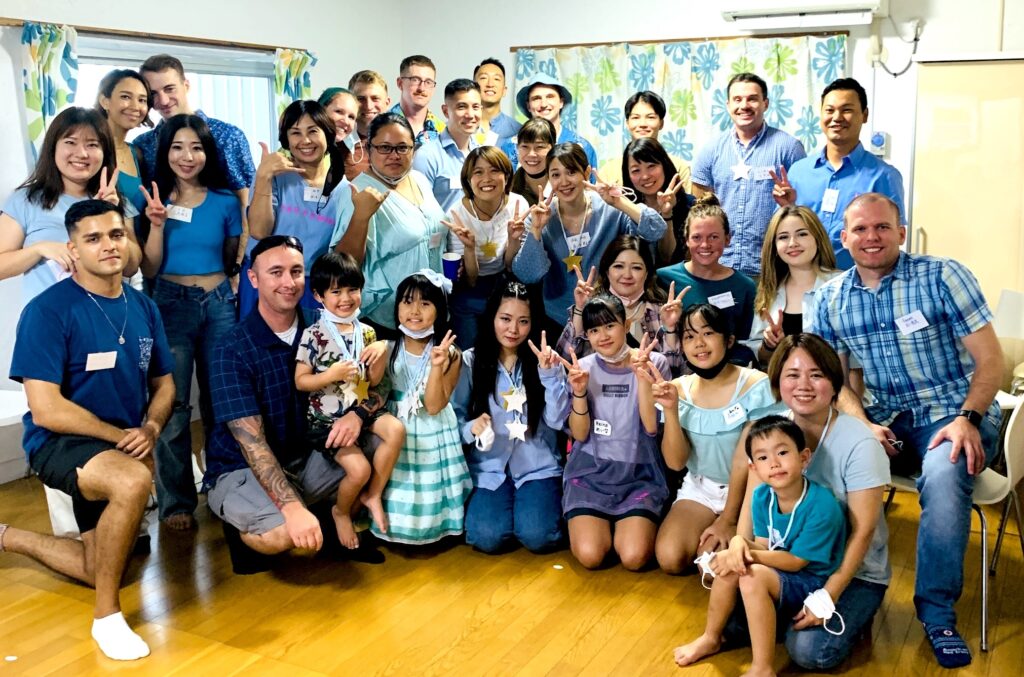
Prepare Something You Really Want to Talk About
The Workbook and the Japanese you are already studying can help you prepare questions and answers about your own life. Instead of stopping with a model sentence from a lesson, you can turn the same grammar and vocabulary into something you would genuinely like to say or ask.
Your notes do not need to be complicated. You might prepare a few questions about someone’s weekend, food they like, a place they have visited, or something happening in Okinawa, along with a little Japanese about yourself in case the same question comes back to you.
What you prepare gives you something specific to ask about and something meaningful to practice. You are not being asked to walk into the room and invent an entire conversation from nothing.
You can prepare what you want to ask. What you cannot prepare is every answer you are going to hear.
If You Miss Something, Ask Again
You ask your question, and the answer comes back a little faster than you expected. Maybe there is a word you have never heard before, or the other person answers in a completely different way from the example you practiced.
You may understand the whole answer, but you may also catch only part of it.
Slow down, pick out what you know, and start from there. Listen to the answer, and if you miss something, ask again: “Mou ichido itte kudasai.”
The other person says it again, and this time you may catch one more familiar word or finally understand what they were trying to tell you. You do not have to understand every word for the conversation to continue; sometimes understanding a little more the second time is enough to keep going.
And after someone helps you with your Japanese, the exchange can turn the other way. The other person is learning too.
Get Help — Then Help Someone Else
Language Exchange is student-driven and designed to be a mutually beneficial learning experience.
You can use the Japanese you prepared with another learner, then help them with the language they are learning too.
Maybe the other person repeated a Japanese sentence more slowly, helped you understand an expression, or showed you another way to say what you meant. When the language changes, you have a chance to help them too — asking questions, sharing cultural insights, and giving each other feedback as the conversation moves back and forth.
Both people are learning. Both people have something to give.
And sometimes, once you stop concentrating only on getting the language right, you begin noticing the person behind the language too. A question about food can turn into hearing about someone’s family; a question about the weekend can lead to a place you have never visited.
The conversation becomes more than practice for a moment. You are learning a little more about another person’s experiences, culture, and point of view.
And the Japanese you used here did not begin here. You brought it with you from your study and class.
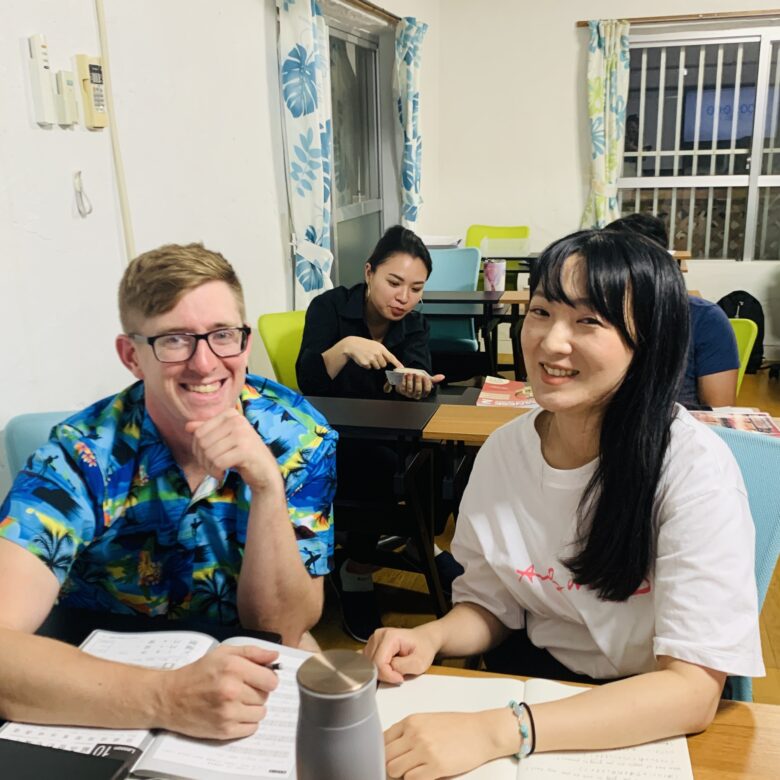
What You Prepare and Practice Can Continue into Language Exchange
Textbook → Study Room → Workbook → Class → Language Exchange
The question you just used may have started with something you learned in your textbook, reviewed in the Study Room, connected to your own life in the Workbook, and checked or practiced in class.
Language Exchange is where that same Japanese can leave the learning materials and meet another person.
Then the conversation gives you something new to bring back. You may hear a new word, discover that you need more listening practice, think of another question you want to ask next time, or simply realize that you would like to know a little more about the person you were talking with.
The conversation gives you something new to learn, and the cycle begins again.
This is one part of the larger way Japanese moves from study into actual use at Blue House.
Every Language Exchange Can Be a Little Different
A real conversation can give you more than language practice. You may hear about another person’s experiences, compare something about life in Japan and another country, or discover a perspective you had never thought about before.
The people you practice with may change from one exchange to the next, so every conversation can be a little different.
Hear from a Student

Garion’s review describes his own experience — arriving nervous, feeling welcomed, and getting to practice Japanese while other students practiced English. It is one student’s experience, so each Language Exchange may feel different depending on who is participating that day.
The people and pairings can change from one exchange to the next, and Language Exchange is not designed as a guaranteed one-on-one pairing or as a guarantee that a particular type of speaker will be present. What stays consistent is the opportunity to use the Japanese you have been building with the people who are there and see where a real conversation takes you.
So the next question is not who you will be paired with. It is what kind of Japanese you want to be able to bring into that conversation.
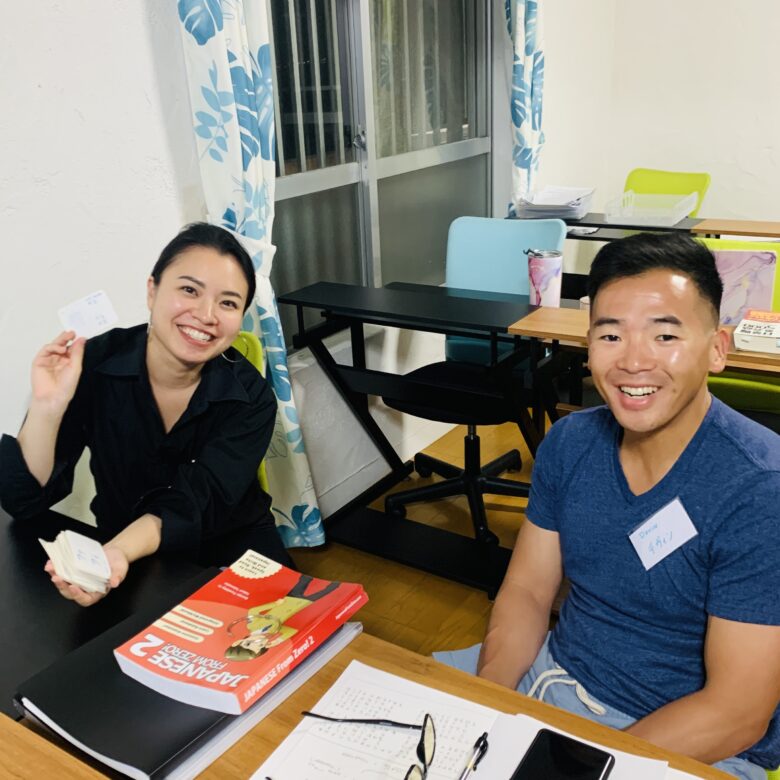
Choose the Japanese You Want to Use
If you are starting Japanese from zero, you can begin by building the foundation. If you have studied before, you can find the course where Japanese starts to feel new again.
And if your main priority is practical speaking, Conversation Class gives you a different route focused more directly on communication.
You do not need to compare every class here. Choose the direction that fits what you want to be able to say, then find the Japanese class that can help you start building toward that conversation.
Focus mainly on practical speaking
Start Here: Conversation
Start Japanese from zero
Start Here: Beginners
Build beyond basic everyday Japanese
Start Here: Pre-Intermediate
Express more detailed ideas and experiences
Start Here: Intermediate
Prepare for JLPT N5, N4, or N3
Start Here: JLPT Test Prep
If practical speaking is your main priority:
If you want to compare the actual vocabulary, grammar, and examples across Blue House courses:
Ready to Start Using Your Japanese?
You do not need to wait until your Japanese feels perfect. Start by learning something you want to say, prepare it, practice it, and then give it a chance to become a real conversation.
If you already know which Japanese course you want, you can continue to the class options and choose how you want to learn.
If you would rather visit Blue House and ask questions before deciding, you can start with a Trial Lesson.
A Trial Lesson is optional. Direct enrollment is also available.